Completing hundreds of PTE Core Speaking questions does not necessarily mean you are practising effectively. If you repeat the same mistakes from one question to the next, more practice may simply reinforce the same weaknesses.
Effective PTE Core Speaking practice starts by identifying the underlying skills that keep affecting your performance across different tasks. These include pronunciation, oral fluency, speaking pace, listening memory, and the ability to organise a response quickly.
If you are still learning how the Speaking section works, including its question types, timing, and scoring, start with our PTE Core Speaking format guide. This article focuses instead on how to practice effectively and how to identify the specific speaking skills that need improvement.
1. Practice Speaking at a Natural, Steady Pace
Speaking faster does not automatically mean better fluency. In PTE Core, the goal is to maintain a natural and reasonably consistent pace while avoiding frequent hesitation, repetition, and unnecessary restarts.
Quick Speaking-Speed Check
Pearson does not publish a specific ideal words-per-minute requirement for PTE Core, so you should not treat any particular number as an official scoring threshold. However, a practical benchmark can help you determine whether you are speaking unusually slowly or rushing.
Use the timer below and try reading the following 50-word passage in approximately 20–25 seconds, which corresponds to roughly 120–150 words per minute:
Speaking Speed check
50 words · target 20–25s
Regular practice can improve speaking confidence when you focus on clear pronunciation, smooth phrasing, and a steady pace. Try to speak naturally rather than rushing. When you make a small mistake, continue without restarting. Record yourself, listen for long pauses, and repeat the same response until it sounds smoother overall.
0:00
Press Start, read the passage aloud, then press Stop when you finish.
If you finish much faster, check whether you are sacrificing clarity. If you take considerably longer, listen for excessive pauses or overly slow delivery. The objective is not to hit an exact number, but to develop a comfortable, controlled speaking rhythm.
A useful practice habit is to record yourself and listen for:
- long pauses between words or phrases
- sentences that become noticeably faster or slower
- repeated words or restarted sentences
- places where you are speaking word by word instead of in meaningful phrases
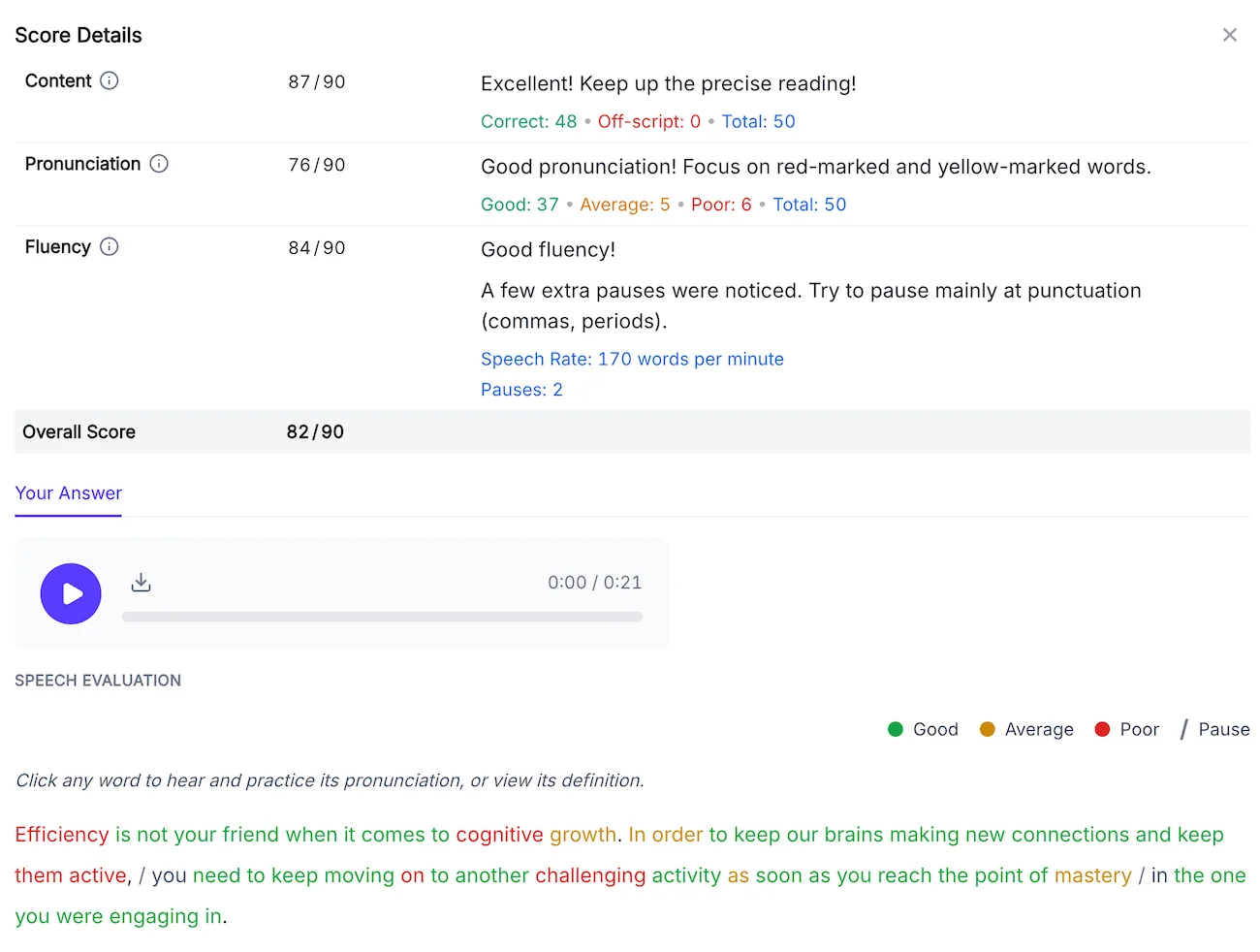
Phrasel provides detailed feedback for each speaking response, including Read Aloud, by separately evaluating content, word-level pronunciation, and fluency. An overall score alone does not show what is limiting performance. This helps learners identify specific weaknesses and focus their next practice session on the areas that actually need improvement.
2. Improve Pronunciation One Difficult Word at a Time
For PTE Core, clear pronunciation matters more than trying to imitate a particular accent. Your speech should be easy to understand, with reasonably accurate sounds, word stress, and sentence stress.
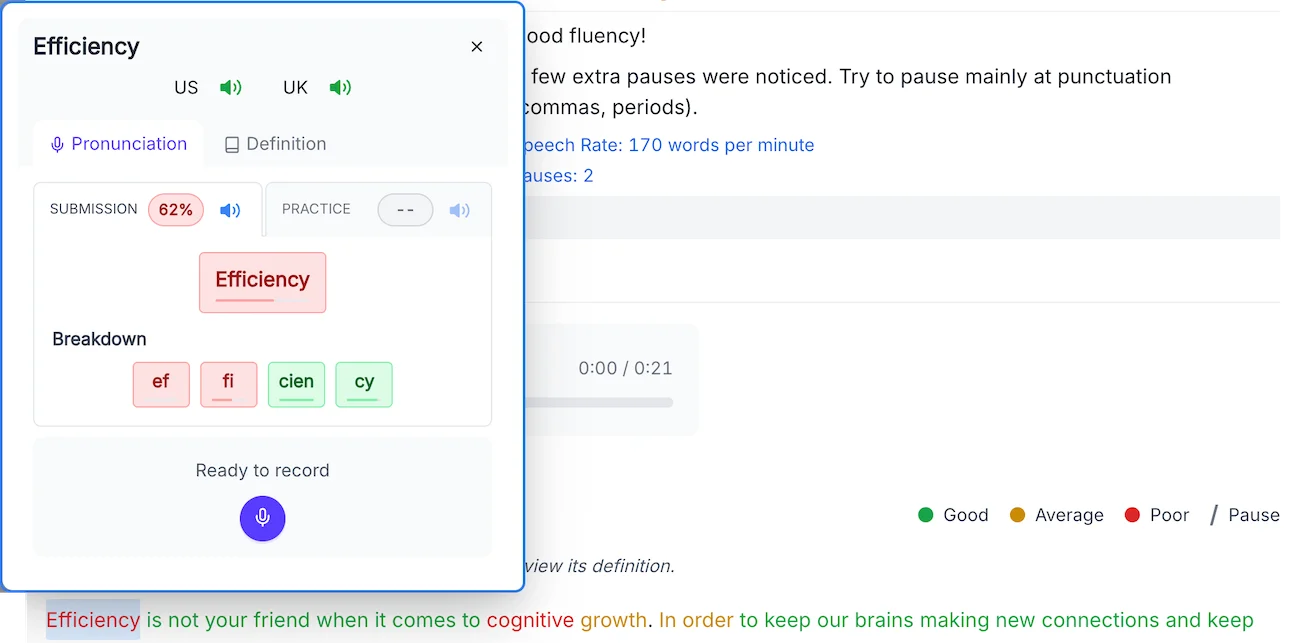
Instead of repeatedly practising an entire response when only a few words are difficult, isolate those words first.
On Phrasel, you can click a word directly on the page to hear its pronunciation and practice it without leaving the exercise. This is particularly useful when you notice that the same word or sound repeatedly causes difficulty.
A simple practice sequence is:
- 1
Listen
- 2
Repeat
- 3
Check the sound
- 4
Use the word in a phrase
- 5
Repeat the full sentence
If you are unsure why a word is pronounced a certain way, you can also use our IPA pronunciation guides. These guides explain the International Phonetic Alphabet symbols used for English sounds and provide examples to help you recognise and produce unfamiliar sounds more accurately.
The goal is not to study IPA in depth. Use it as a practical reference whenever you encounter a sound you consistently mispronounce.
3. Train Listening and Short-Term Memory for Repeat Sentence
Repeat Sentence tests more than pronunciation. You must listen, temporarily retain the sentence, and reproduce as much of it as possible while maintaining natural speech.
Cognitive psychology has long shown that chunking can make this easier. Working memory handles information more efficiently when individual elements are grouped into meaningful units rather than remembered separately.
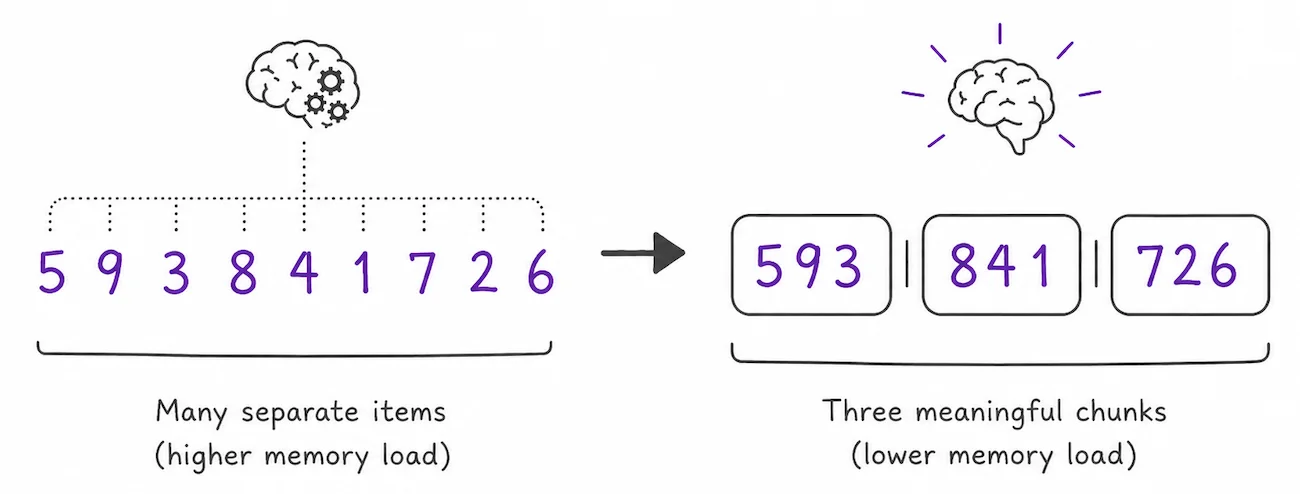
In practice, instead of trying to remember every individual word, divide the sentence mentally into meaningful groups.
For example:
The new community centre / will open next month / near the train station
During practice, begin with shorter sentences and gradually increase their length. Focus on remembering:
- the main meaning
- important content words
- the order of the major phrases
Try to reproduce the sentence immediately rather than spending too much time mentally reconstructing missing words. With repeated practice, this can improve both listening memory and speaking fluency.
4. Practice Turning Information Into Speech Quickly
Some PTE Core Speaking tasks give you relatively little time to organise your ideas before recording starts. The goal is not to create a perfect answer in your head, but to identify a simple speaking path quickly and start clearly.
Having a general structure that you already feel comfortable with can make this much easier. You do not need to memorise complete responses, but it helps to have a small set of flexible phrases for common functions such as introducing the main idea, comparing information, giving a reason, making a request, or closing politely. This reduces the amount of language you need to generate from scratch while the timer is running.
For example, in Describe Image, use the preparation time to identify just three things: what the image is mainly about, two or three important details, and one useful comparison or overall observation. Then follow a simple structure:
What the image is mainly about
Two or three important details
One useful comparison or connection
A short closing comment
For example, instead of trying to mention every number in a chart, identify the highest and lowest values, any clear trend, and one useful comparison. Familiar phrases such as The image shows…, Compared with…, or Overall, the main feature is… can help you move through the response smoothly.
For Respond to a Situation, quickly decide: Who am I speaking to? What do I need to communicate? What action or solution should I suggest? Then organise your response as:
Why you are speaking
The key details the listener needs
What you want the listener to do or understand
A natural, appropriate ending
Useful phrases might include I just wanted to let you know…, Would it be possible to…, or I think a better option would be….
The aim is to make the structure and common phrases automatic enough that you can focus on the actual prompt, rather than spending valuable seconds deciding how to form every sentence. For ready-to-use structures and phrase examples, see our PTE Core Templates guide.
Final Takeaway: Use a Practice–Feedback–Repeat Cycle
This point is simple, but extremely important. Effective speaking practice is not about completing as many questions as possible. One of the biggest mistakes is moving from one response to the next without identifying why the previous response was weak.
If your response receives weak pronunciation feedback, doing ten more Describe Image questions may not solve the problem. Instead, identify the specific words that caused difficulty, use the built-in pronunciation tool to practice them, refer to the IPA guide when needed, and then answer the same question again.
Likewise, if the problem is fluency, repeat the same response several times while focusing specifically on pauses, rhythm, restarts, and continuity. Repetition with a clear purpose is often more useful than simply increasing question volume.
The key is the Practice–Feedback–Repeat cycle. That is what turns repeated questions into measurable speaking improvement.
Practice speaking questions with scored feedback on content, pronunciation, and fluency, then repeat the same item after targeting one specific weakness.
Frequently Asked Questions
Does speaking faster improve PTE Core fluency?
No. Fluency is about a natural, reasonably consistent pace with limited hesitation, repetition, and restarts. Rushing can reduce clarity and make your speech harder to follow.
How should I practice PTE Core Speaking if I keep making the same mistakes?
Do not move on immediately. Identify the specific issue, such as a difficult word, a long pause, or a weak structure, correct that one point, and then repeat the same question.
How can I improve pronunciation without changing my accent?
Focus on being easy to understand. Practice difficult words one at a time, check word stress, and use IPA only as a reference for sounds you consistently mispronounce.
How do I remember more of a Repeat Sentence?
Group the sentence into meaningful chunks instead of trying to remember every word separately. Hold the main meaning, the key content words, and the order of the major phrases, then start speaking immediately.
What is the Practice–Feedback–Repeat cycle?
Complete a response, review the specific feedback, target one weakness, and try the same question again. This is more effective than completing a large number of new questions without review.
Tags:
- #pte-core-speaking
- #speaking-practice
- #fluency
- #pronunciation
- #oral-fluency
- #repeat-sentence
- #describe-image
- #pte-core